This is the final paper I wrote for my class, Erosion of Democracy. I took this class in the spring of my junior year. Even though this class is a government class cross-listed with Latin American Studies, we actually ended up spending a lot of time talking about the United States and the state of democracy in the US. In the spring of my junior year, President Donald Trump had just been reelected president, so for one hour out of my three-hour-long seminar, we would talk about moments of signals of eroding democracy in the United States.
Although that was very pessimistic to hear for an hour each week, I ended up learning a lot about backsliding democracies and what it is like to be experiencing some of the initial stages. This class was taken a couple of months after my trip to China, an authoritarian country, so I also knew a little what it was like to live in a fully authoritarian society. For this section of class, we talked a lot about how scary it was to see our checks and balances in the government seem nonexistent at times, and even the media being complacent to the situation. Since the class took place right at the beginning of Trump’s second term, there were many in the class who started out skeptical of using the backsliding democracy lens on the United States, but as we got towards the end of the semester, the list of moments of backsliding that we had compiled was 43 pages long of links to news articles. What I personally found scary about this was that, because of my time in China, I understood that life can progress quite well and functionally for the most part in an authoritarian regime, at least for myself. The government knew that I was international and educated about topics that are banned, so they only minded that I did not talk to native Chinese citizens about my ideas. This class had me thinking a lot about the way of life under democracy and autocracy.
As I mentioned, this class made me reflect a lot about life under three types of regimes: democracy, democratic backsliding, and autocracy. It is what gave me the idea for my three sections in this eportfolio. This eportfolio looks at many different countries that I have either studied or been to, and they can all fall under one of those categories.
For the other two hours of the class, the framework was that one hour we would have a lecture from the professor about theories in the erosion of democracy, and then the next hour we would talk about our case studies and apply the theories there. Each person had their own country that they were researching. I had chosen El Salvador because it is an extremely recent example of a backsliding democracy, and also because at the time, El Salvador was in the news a lot for its relations with the United States. This paper is a compilation of the theories of democratic backsliding I had studied throughout the semester used as a lens to look at El Salvador from 2018 to 2025. It also inspired me to write a similar paper about democratic backsliding in Turkey.
Paper:
El Salvador under Bukele, 2018-2025: Autocratizing a Democracy
- Introduction
Political theorists have warned that while in the short term, populism can increase levels of democratic representativeness, populist leaders can threaten democratic institutions by positioning themselves as the only person capable of speaking for the majority of the people and undermining checks and balances, rather than protecting citizen’s rights (Mudde et al. 2017, 84). Populists often erode the institutional safeguards designed to protect civil liberties and ensure accountability under the pretense that they have a redemptive mission for the people (Weyland 2024, 391).
Weyland (2024) outlines why populism emerges. He says that populism is a political strategy “revolving around personalistic, usually charismatic leadership that is sustained by direct, unmediated, uninstitutionalized connections to a heterogeneous, amorphous, and largely unorganized mass of followers” (391). An example of a country following this pattern today is El Salvador. Since his rise to power in 2018, President Nayib Bukele has dismantled institutional constraints and has framed himself as the sole representative of the people. His quick consolidation of power highlights how vulnerable democratic systems can be to populist strategies, especially when existing institutions are already weak.
This paper analyzes the autocratization of El Salvador under populist leader Nayib Bukele through the lens of government accountability. Lührmann et al. ‘s (2020) framework of accountability looks at the extent of checks on the government by civil society, state institutions like the judiciary and legislative branches, and the media. He calls these three methods of accountability vertical accountability, horizontal accountability, and diagonal accountability, respectively. Through this lens, this paper argues that Bukele has systematically eroded all three forms of accountability while maintaining the appearance of democratic legitimacy.
First, the paper will look at the conditions in El Salvador that led to Bukele’s rise to power. In section 2, the paper will look at how Bukele’s use of the media, such as Twitter, paved the way for his populist rise to power. Section 3 is about how Bukele took advantage of the COVID-19 pandemic to consolidate power in the legislative and judicial branches. Section 4 looks at the individual voters’ reasons for electing Bukele.
- The Conditions of Populism
The current political climate in El Salvador is shaped by a history of polarization beginning before President Bukele’s rise to power. Two axes of polarization were formed after the Civil War: the elites versus the common people.
After the 1979-1992 Civil War in El Salvador, two parties emerged, the ARENA and the FMLN. The ARENA, the right-wing party, was business-friendly and known for being pro-law-and-order. Conversely, the FMLN was the party for social justice and change. In the media, the ARENA was portrayed positively while the FMLN was portrayed negatively (Wolf 2020, 21). As the ARENA’s goals align closer to the interests of the conservative, traditional elites who were running the media, their ideas were framed positively, while the FMLN’s ideas– those that rallied for social change and income redistribution were smeared and discredited (Wolf 2020, 21).
While the political landscape of El Salvador in the 2010’s was characterized by the divisions between the ARENA and the FMLN, as time wore on, the FMLN administrations became more business-friendly, and their social programs were established within the neoliberal economic model, not a socialist republic which the media had warned people of in the past (Wolf 2020, 29). Rather than subvert the media and continue to rally for economic restructuring and social change, the FMLN made compromises, working within the systems of the elite and moving their platform closer to that of the ARENA. Meanwhile, the ARENA was also shifting away from the right, after accusations of corruption and money laundering were aimed at the far-right section of their party (Wolf 2020, 24). As the ARENA and FMLN began to converge, a large segment of Salvadoran society– the common people– was left unrepresented in parties filled with elites. 78% of voters in 2018, right before Bukele’s first election, felt neither party represented them (Meléndez-Sánchez 2021, 20). This meant that a large majority of voters were seeking new options outside the two traditional parties.
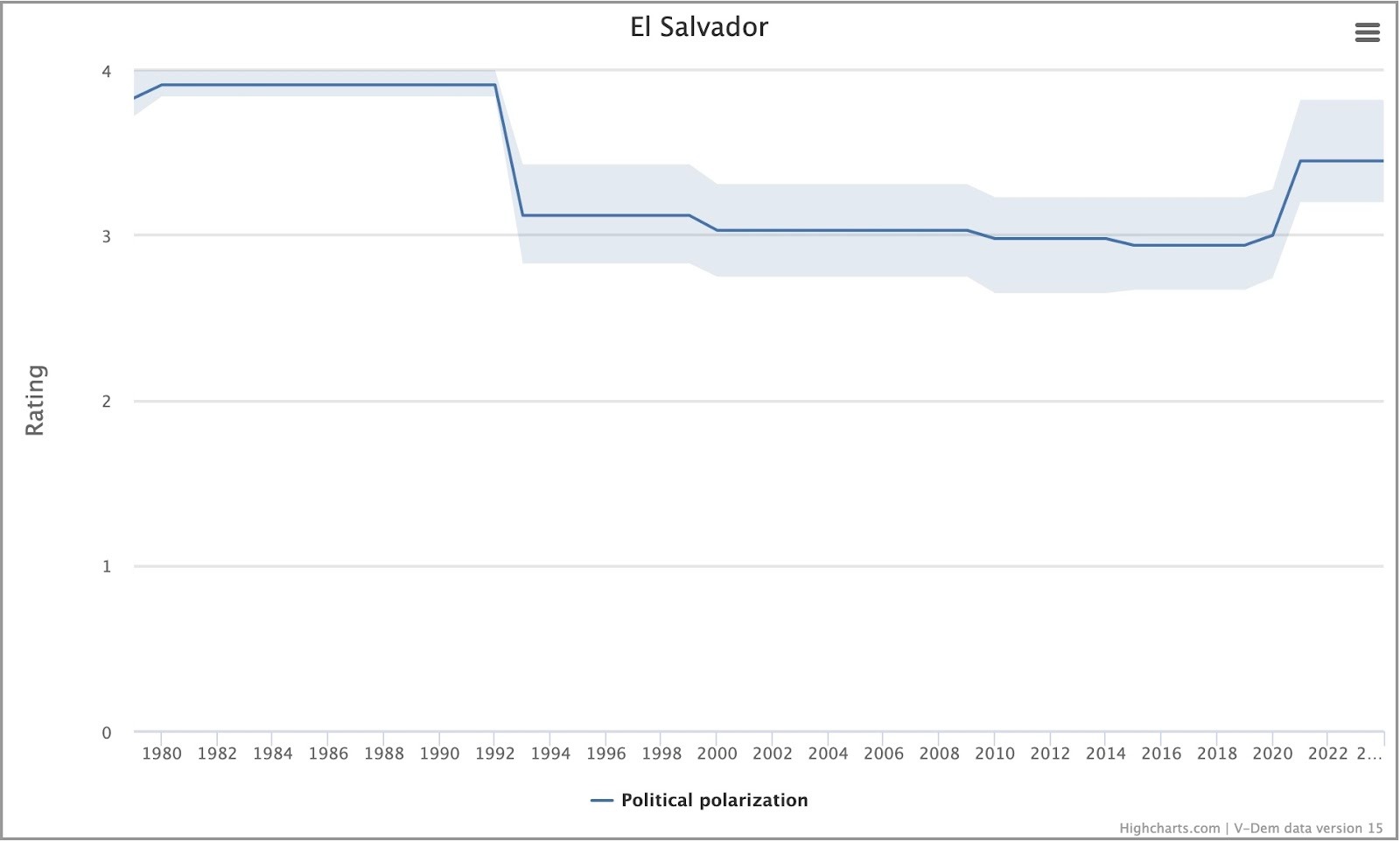
Graph 1 shows polarization in El Salvador in the post-Civil War era. The variable “Political Polarization” measures the extent that political differences affect social relationships. In highly polarized societies, people are unlikely to have friendly relations with people of opposing parties, whether it is family arrangements or workplaces. A rating of 0 indicates no political polarization, while a rating of 4 shows that opposing groups act in a hostile manner towards each other (V-Dem, n.d.). The graph shows that polarization in El Salvador has remained high ever since the Civil War, rarely dipping below a rating of 3. This is due to the divide between the common people and the elites in Salvadoran society.
Graph 1: Polarization
(V-Dem, n.d.)
Milan Svolik argues that in polarizing democracies, voters are more willing to sacrifice democracy in the hope of electing a politician who aligns with their interests (Svolik 2019, 24). An increasing divide between the two ends of polarization leaves fewer people in the political center. People in the political center are more likely to encourage democratic norms. Without these people, there is a tenuous state where democratic principles are more likely to be eroded. As the political divide between the elites and the common people increased, those whose voices had historically been in the middle, like the FMLN, disappeared, leaving a large divide in the center and importantly, pushing common people away from the elite and toward another leader.
- Digital Authoritarianism and Bukele as a Populist
Digital authoritarian practices erode diagonal accountability by removing the role of the media in holding the government responsible for its actions. Digital authoritarian practices have become powerful weapons for autocratizing leaders to increase surveillance, censorship, disinformation, and ultimately erode democratic values.
In El Salvador, Nayib Bukele has relied heavily on social media platforms such as Twitter to amplify his voice without the restrictions of traditional media platforms. Many studies highlight Bukele’s use of social media for political discourse, calling him a cyber-populist or a millennial-authoritarian leader (Luján and Lombardi 2025, 4). During his campaign, Bukele used Twitter to have direct communication with the Salvadoran people, earning him the nickname of a “millennial populist”. To the Salvadoran people, Bukele was seen as “young and ‘cool’” (Weyland 2024, 109), a stark contrast from the defaced reputations of the ARENA and the FMLN.
By leveraging social media, Bukele bypasses the checks by the media, providing unfiltered communication to the people through platforms such as Twitter, framing himself as a champion of the working class (Wolf 2020, 32). His method to get information out to the public can be considered a “flood the gate” approach in which he overwhelms people with his information alone, drowning out voices of resistance. For example, in July 2024, over 20,000 tweets were published by both the President and pro-government social media accounts, and some tweets had over six million views (Wolf 2024, 309). This methodology has positioned Bukele as an outsider in the traditional political landscape, one who moves away from the elites who had consolidated political power.
However, not using formal methods of media means that Bukele and his followers can spew any information they want to the public. In El Salvador, the qualitative indicators of digital authoritarianism provided by the Digital Society Project have contributed to the increase in autocratization and erosion of democracy under President Nayib Bukele. Twitter, unlike press conferences and other traditional forms of media, can quickly disseminate information both domestically and abroad without formal institutions fact-checking (Wolf 2024, 309). In fact, according to the Digital Society Project, domestic dissemination of false information has changed by 47% under Bukele, and dissemination of false information abroad has changed by 50% (McGuire 2025, 26). Furthermore, Bukele has taken advantage of the automated bots and anonymous trolls on social media to control narratives, issue public orders, and attack critics. Journalists have faced harassment, defamation, surveillance, and exile, which creates a climate of fear and self-censorship (Wolf 2024, 310). Accordingly, social media censorship has decreased by 10%, social media monitoring has also decreased by 25%, and internet monitoring has decreased by 6% (McGuire 2025, 26). These digital authoritarian practices have weakened individual freedoms and freedoms of the media, successfully chipping away at democratic values. Bukele’s use of social media to directly communicate with the Salvadoran people shows unmediated and uninstitutionalized connections to his followers.
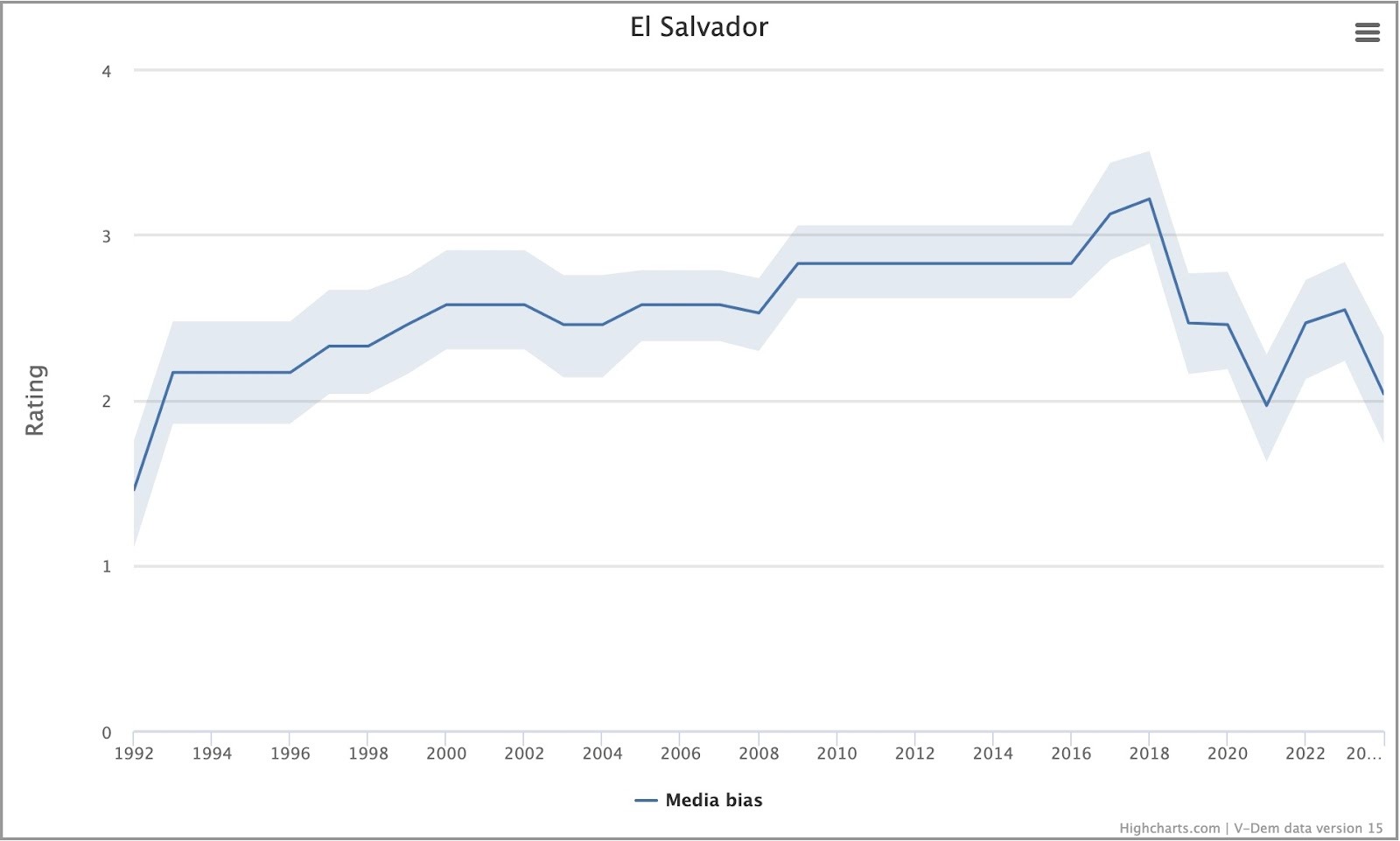
Graph 2 shows how fair media coverage has gone down since Bukele’s election and how polarization has gone up. “Media Bias” measures whether the media covers a mix of positive and negative coverage on each party and candidate. A lower rating indicates that the media favors coverage of the official party and candidates but the opposition candidates receive only negative coverage. A high rating shows that all parties and candidates receive impartial coverage (V-Dem, n.d.). Prior to Bukele’s campaign in 2018, media bias had climbed up to the 3-4 range, indicating that there was relatively fair coverage of the candidates. After his election, this rating has dipped down to a 2, showing that opposition candidates receive more negative coverage. This makes sense because of the political attacks on journalists, which would make media outlets fearful of publishing material that frames Bukele and his party in a negative light.
Graph 2: Media Bias
(V-Dem, n.d.)
Bukele’s unchecked direct communication to his mass of followers and charismatic leadership show a textbook definition of a populist leader. As Mudde et al. (2017) warn, populism may lead to the erosion of democratic structures. This is certainly true with El Salvador. Bukele’s use of social media has weakened diagonal accountability in El Salvador. While the traditional media can provide a check on power by exposing corruption and offering a platform for diverse voices, Bukele instead uses Twitter to control his narrative and flood out criticism. By sidelining journalists and mass spreading disinformation, Bukele limits the public’s access to independent information.
- Erosion of Democratic Structures
Horizontal accountability has also eroded under Bukele. Kurt Weyland (2020) and Haggard and Kaufman (2021) look at explanations for why democracies autocratize by looking at the structures within a democracy. Weyland (2020) claims that transformations like these happen because of an economic crisis and institutional weaknesses. Haggard and Kaufman (2021) identify control over the legislature as the defining point in democratic backsliding. The legislature is important in providing horizontal checks on the executive branch and assuring rule of law and compliance with democratic and administrative procedure (Haggard 2021, 56). In both cases, checks and balances by democratic institutions are eroded. Both these theories are true in the case of El Salvador.
Soon after Bukele entered office in February 2019, the world was hit with the COVID-19 pandemic. The pandemic was an economic shock that forced countries to shut down. It was a chance for Bukele to declare a “state of exception” over the country and consolidate power after he was elected in 2019. This move allowed the government to use violence to crack down on the Salvadoran population. Though initially the crackdown on crime effectively tackled the gang violence problem in the country, a huge human rights concern emerged as people are being put in jail at an alarming rate, and for non-transparent reasons. The judicial branch attempted to stop this by ruling to lift the state of exception; however, these rulings were ignored by Bukele, a direct violation of judicial checks on the executive (Weyland 2024, 111).
While the state of exception undermined democracy and rule of law, the measures were effective in minimizing the spread of the disease and decreasing crime rates (Weyland 2024b, 112). President Bukele was able to build support during the pandemic because of the public perception that security, particularly gang violence, has improved under the State of Exception, even though these gains have come at the expense of democracy and human rights (Boerman 2024, 4-5). Bukele’s treatment of the pandemic, his proactiveness in seeing results, and the lengths he went to to help the Salvadoran people gave him overwhelming support and helped his party sweep the 2021 legislative elections, solidifying his official takeover of the legislative and executive branches.
Bukele’s judicial takeover was also speedy. In August 2021, the legislative assembly enacted a judicial reform law aimed to get rid of what they deemed were corrupt judges and replace them with loyalists (Wolf 2024, 299). This move effectively allowed Bukele to take over the judicial branch as well. Soon after, in September 2021, the Supreme Court allowed Bukele to run for an unconstitutional re-election in 2024 (Wolf 2024, 299), showing the beginning of a gradual breakdown of electoral rules and norms. With control over the executive and legislative branches and a judiciary branch whose rulings he had been circumventing since the pandemic, Bukele had sufficiently consolidated power.
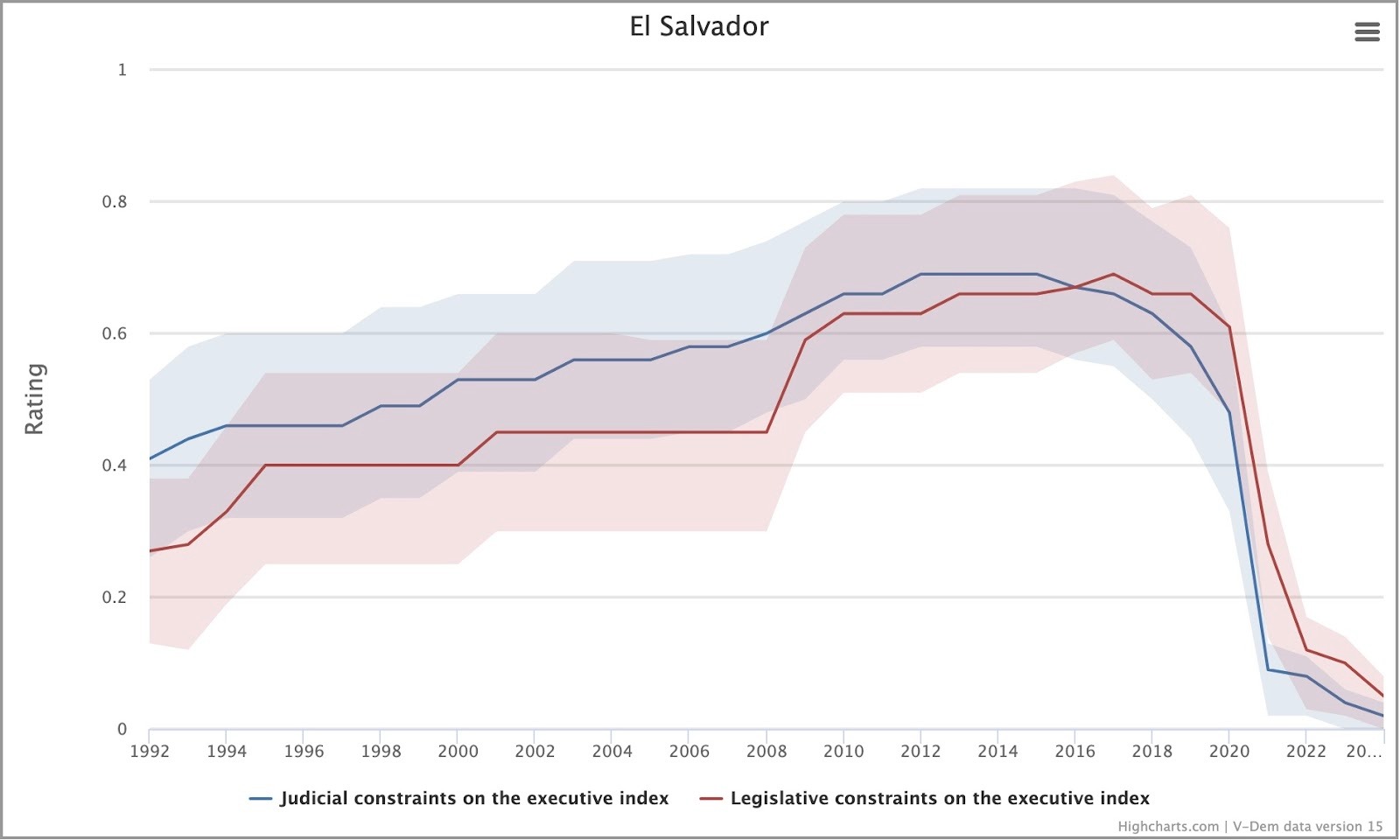
Graph 3 demonstrates how both Legislative and Judicial constraints on the Executive branch have gone down since 2018, the election of Bukele, with a strong dip right around 2021. Although Bukele was able to have loyalists in the Legislative branch before the Judicial branch, the graph shows the Judicial constraints dipping before the Legislative branch. This, however, is accurate because prior to officially taking over the Judicial branch, Bukele was ignoring their rulings anyway, showing a lack of strength of Judicial constraints.
Graph 3: Legislative and Judicial Constraints on the Executive
(V-Dem, n.d.)
Haggard and Kaufman’s emphasis on legislative checks and Weyland’s theory on institutional weakness and autocratization both help explain democratic backsliding in El Salvador. While Bukele maintains popular support due to his crackdown on gang violence and his pandemic response, this support has come at the expense of eroding democratic structures. Bukele’s takeover of the legislative and judicial branches is fundamental to the breakdown of horizontal accountability in El Salvador. Through elections, loyalist appointments, and ignoring court rulings, Bukele has found ways to manipulate the democratic structures in El Salvador into a tool for his autocratizing power.
- Free and Fair Elections?
El Salvador’s relationship with vertical accountability is not as clear cut as the other forms of accountability. Looking at the surface level, President Bukele has won elections with overwhelming support and legitimate votes, making it seem as though democratic procedures are intact. However, looking closer suggests that this electoral success is not necessarily a reflection of democratic values. Instead, Bukele’s popularity is tied to CSO repression, government censorship efforts, and election government intimidation. While citizens still can vote, the political climate under which people are voting suggests that these votes may not be free and fair. As a result, vertical accountability in El Salvador persists more in appearance than in practice.
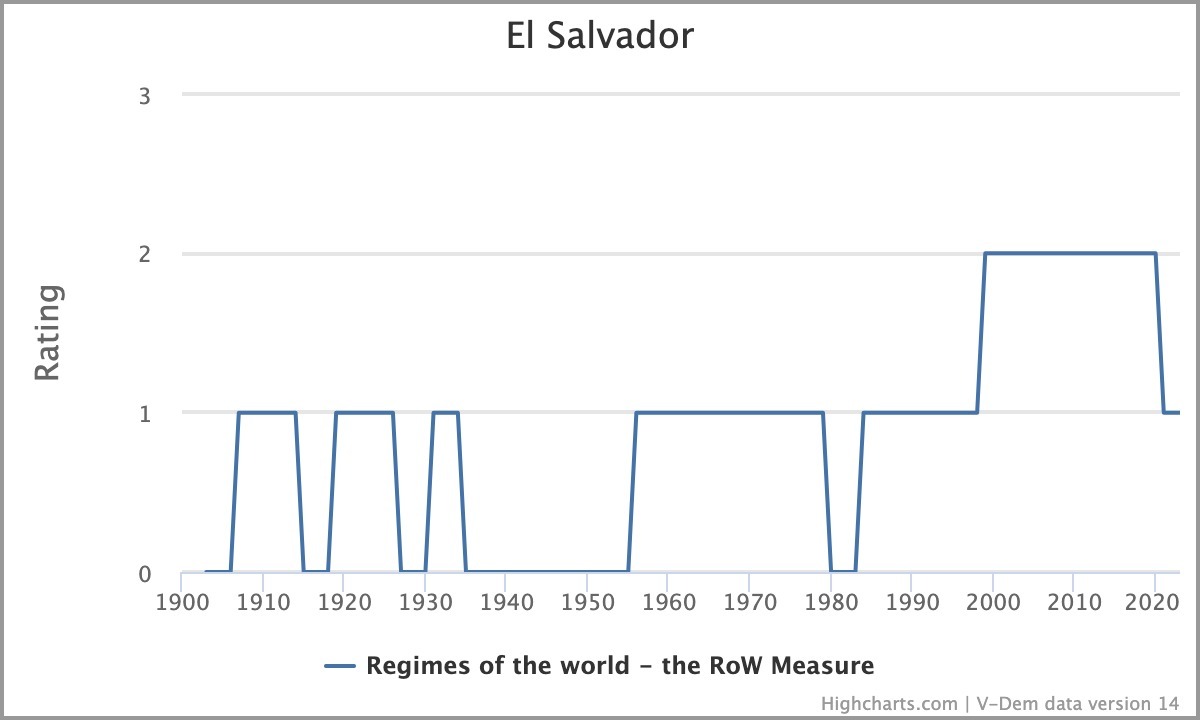
Varieties of Democracy (V-Dem) is a method to measure democracy levels in a given country. V-Dem uses Dahl’s theory of polyarchy to provide a comprehensive look at the type of government in each country (Luhrmann, 2022, 62). Prior to 2020, El Salvador was categorized as a Electoral democracy: the free and fair multiparty elections met the minimum level of Dahl’s prerequisites for polyarchy, but there was not sufficient access to justice, transparent law enforcement, liberal principles of respect for personal liberties, rule of law, and judicial as well as legislative constraints to meet V-Dem’s standards (V-Dem, n.d.). However, after the 2021 election, that label changed to an “electoral autocracy”. This is because there are multiparty elections for the chief executive and the legislature, but these elections are not free and fair, failing to meet the prerequisites of polyarchy as measured by V-Dem (V-Dem, n.d.). Graph 3 shows that El Salvador has recently been categorized as an Electoral autocracy.
Graph 3: Measure of Democracy
(V-Dem, n.d.)
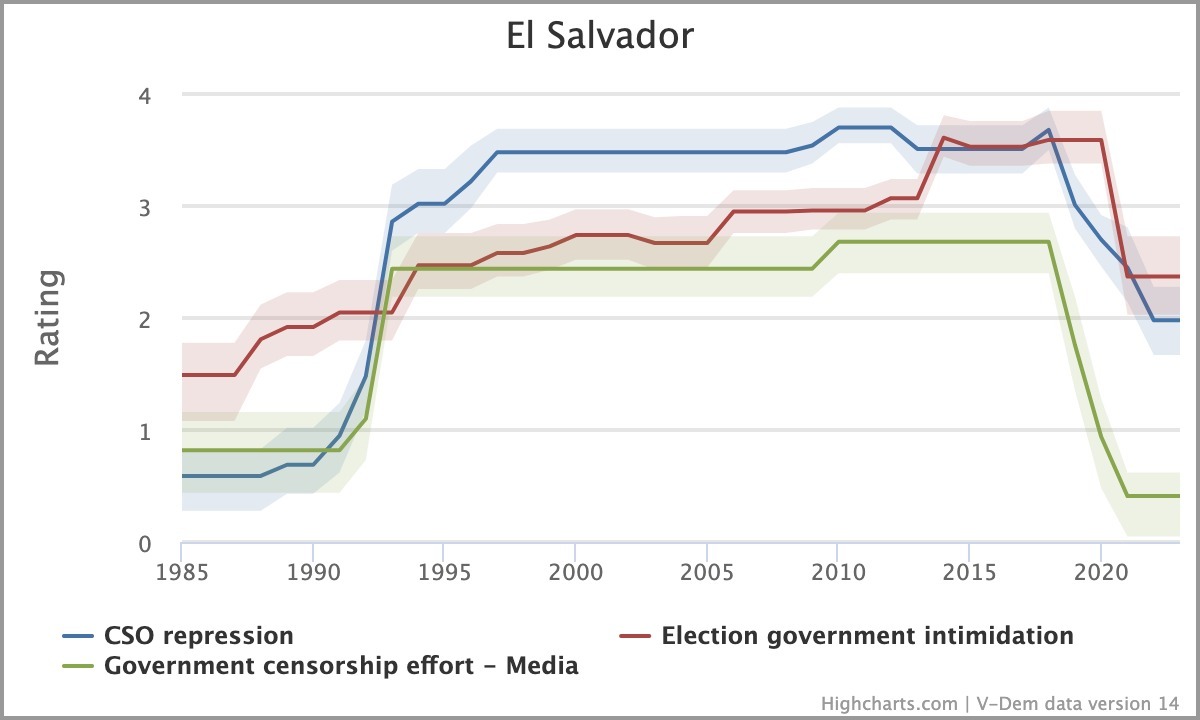
To break down the reasons for why El Salvador is no longer considered to be an electoral democracy, three V-Dem indicators were isolated: CSO repression, government censorship efforts, and election government intimidation. These indicators span critical democratic dimensions—freedom of association, freedom of expression, and electoral integrity. CSO repression reveals the extent to which civil society organizations have been restricted, particularly after 2020. Government censorship efforts highlight limitations on dissent and the suppression of alternative viewpoints. Election government intimidation signals interference with electoral processes through coercive means. As shown in Graph 4, each of these measures declined significantly around 2020, marking a turning point in El Salvador’s democratic trajectory. Since then, Bukele has intensified attacks on press freedom (Wolf, 2021: 65) and undermined the independence of the legislative branch (Wolf, 2021: 66). V-Dem data reflects this shift, showing that Bukele’s government has increasingly suppressed civil society through censorship and intimidation, contributing to the country’s transformation from an electoral democracy to an electoral autocracy.
Graph 4: Breakdown of Measures of Democracy
(V-Dem, n.d.)
The breakdown of many democratic measures can help explain why Bukele won the support of 85% of the people, despite blatantly ignoring judicial rulings and eroding democratic structures. Going even deeper to the individual reasons for voting for Bukele gives even more insight. Hellmeier and Leuschner (2024) state, “While voters do not approve of undemocratic practices in general, they become more willing to accept such behavior if it is in line with their ideological preferences” (175). Voters may support an undemocratic candidate if this candidate aligns with their own goals and identity. Gang violence had consumed El Salvador prior to the 2019 election and had the power to unite voters. For thirty years, gang violence had impacted most Salvadorians. Upon taking office, Bukele announced a state of emergency and began cracking down on gangs, incarcerating 2% of the population. This initiative helped boost Bukele’s popularity (Wolf, 2024, 305-306). Given the extent of the gang violence problem in the country, Bukele’s crackdowns were able to unite voters around this problem and in support of Bukele and his party, making them willing to accept undemocratic practices that may be simultaneously happening.
This ties back to Bukele’s populist nature. Bukele has sufficiently positioned himself, through his mass tweets, as the sole person who can represent the people, stressing the dangers that populism can have on a democracy. People in El Salvador are willing to accept the rejection of democracy and human rights because many feel the concepts of democracy and human rights have failed them (Boerman 2024, 5). Many are willing to support a populist authoritarian regime because human rights and democratic principles were already undermined during democracy, and they are willing to accept the tradeoff between having safer streets or democracy.
While elections remain a fundamental feature of Bukele’s presidency, a closer look into the democratic conditions for why Bukele was able gain so many supporters, CSO repression, government censorship efforts, and election government intimidation, show that while the votes he gained are legitimate, the climate in the country does not work towards building free and fair elections. Looking at individual reasons for voting for Bukele shows that people may be aware of the undemocratic practices but willing to overlook them because of the perception that Bukele is the only president who has been speaking for the desires of the common people. While elections are technically legitimate, the conditions under which people are voting are not free and fair, displaying a lack of vertical accountability.
- Conclusion
Now, Bukele is effectively an authoritarian leader operating within the structures of a democracy. The speed of the onset of autocratization is remarkable. Between 2018 and 2021, Bukele was able to dismantle checks and balances, showing how fragile democracies can be in the face of an autocratic leader.
Nayib Bukele has successfully taken away diagonal, horizontal, and vertical accountability on himself and his government. Much of this has to do with the state of the country prior to his election campaign in 2018. Decades of unaddressed gang violence and weak existing parties, the ARENA and the FMLN, to deal with them meant that many citizens felt unrepresented in politics. Bukele was able to capitalize on this dissent and rise to power as a populist leader. Through his “millennial populism” Bukele has taken over traditional forms of media and presented himself as the sole representative of the common people, leading to people ignoring his undemocratic practices, such as the erosion of democratic structures in the legislative and judicial branches.
El Salvador is an interesting case study for a quickly autocratized country. He shows how a leader can use popular discontent, institutional weaknesses, and a crisis to dismantle government accountability, a good blueprint for aspiring autocrats and a warning for democratic nations.
- References
Boerman, Thomas, Tommie Sue Montgomery (2024). “Intentional Injustice: Destroying the Rule of Law in El Salvador.” Research Gate. Columbia University’s Center for Mexico and Central America.
Castro, Joaquín. 2021. “Bukele responde a la avalancha de repudio internacional: el pueblo votó por esto.” El Faro. https://elfaro.net/es/202105/el_salvador/25453/Bukele-responde-a-la-avalancha-de-repudio-internacional-el-pueblo-vot%C3%B3-por-esto.htm.
Correal, Annie. 2025. “Bukele Has Power to Return Deportee in El Salvador to U.S., Experts Say.” The New York Times. https://www.nytimes.com/2025/04/16/world/americas/el-salvador-bukele-abrego-garcia.html.
Dahl, Robert (1998). On Democracy. New Haven, CT: Yale University Press, 35-43, 83-99.
Goebertus Estrada, Juanita. 2025. “El Salvador’s prisons are no place for US deportees.” The Hill. https://thehill.com/opinion/international/5161360-el-salvador-prison-abuse/.
Haggard, Stephan, and Robert R. Kaufman (2021). Backsliding: Democratic Regress in the Contemporary World. New York: Cambridge University Press.
Hellmeier, Sebastian, and Elena Leuschner (2024). “Elections and Autocratization.” Chapter 12 (166-180) in Aurel Croissant and Luca Tomini, eds., Routledge Handbook of Autocratization. New York: Routledge.
King, Thad. 2025. “Nayib Bukele | Biography, Family, Gang Crackdown, Popularity, & Ethnicity.” Britannica. https://www.britannica.com/biography/Nayib-Bukele.
Lührmann, Anna, Marcus Tannenberg, and Staffan I. Lindberg (2018). “Regimes of the World (RoW): Opening New Avenues for the Comparative Study of Political Regimes.” Politics and Governance 6 No. 1, 60-77.
Luján, Diego, and Gonzalo P. Lombardi (2025). “The personalistic challenge: The rise of Bukele and the collapse of an ideologically structured party system in El Salvador.” In International Political Science Review. 10.1177/01925121251321566.
McCoy, Jennifer. (2023). “Hyper-Polarization and the Security of Democracy.” In Nicholas A. Seltzer and Steven Lloyd Wilson, eds., Handbook on Democracy and Security. Northampton, MA: Edward Elgar. Chapter 10, 165-187.
McGuire, James (2025). “Personalism, the Rule of Law, and Autocratization.” Government 382: Erosion of Democracy. Class lecture at Wesleyan University, Middletown, Connecticut, April 16, 2025.
Meléndez-Sánchez, Manuel (2021). “Latin America Erupts: Millennial Authoritarianism in El Salvador.” Journal of Democracy 32, no. 3 (2021): 19-32. https://dx.doi.org/10.1353/jod.2021.0031.
Mudde, Cas, and Cristóbal Rovira Kaltwasser (2017). Populism: A Very Short Introduction. New York: Oxford University Press. Chapter 5, “Populism and Democracy,” 79-96.
Olivares, José. 2025. “Human rights groups rebuke Kristi Noem’s visit to El Salvador prison: ‘political theater.’” The Guardian.
Skaaning, Svend-Erik (2021). “Democracy: Contested Concept with a Common Core.” Chapter 1 in Gordon Crawford and Abdul-Gafaru Abdulai, eds., Research Handbook on Democracy and Development. Cheltenham: Edward Elgar, 27-43.
Svolik, Milan W. (2019). “Polarization versus Democracy.” Journal of Democracy 30 No. 3, 20-32.
V-Dem. n.d. “Country Graph.” V-Dem. Accessed May 15, 2025. https://v-dem.net/data_analysis/CountryGraph/.
Weyland, Kurt (2024). Democracy’s Resilience to Populism’s Threat: Countering Global Alarmism. Cambridge: Cambridge University Press.
Wolf, Sonja. (2020). Spoilers of the Peace: Elites and the News Media in El Salvador (1992-2019). EIAL – Estudios Interdisciplinarios De América Latina Y El Caribe, 30(2), 15–39. https://doi.org/10.61490/eial.v30i2.1626
Wolf, Sonja. (2021) “A Populist President Tests El Salvador’s Democracy.” Current History. https://watermark.silverchair.com/curh.2021.120.823.64.pdf?token=AQECAHi208BE49Ooan9kkhW_Ercy7Dm3ZL_9Cf3qfKAc485ysgAAA4AwggN8BgkqhkiG9w0BBwagggNtMIIDaQIBADCCA2IGCSqGSIb3DQEHATAeBglghkgBZQMEAS4wEQQMixr9pNnlOm9JK66OAgEQgIIDM3asFi-6CLa1aQ1WbqV8HHxkPoMfsAPfcnk.Wolf, Sonja. (2024). “El Salvador Under Nayib Bukele: The Turn to Electoral Authoritarianism.” Revista de ciencia política (Santiago), 44(2), 295-321.
