This is the script for a podcast for an assignment that I did for my class when I was in Spain the winter of my Junior year. The class was an art history class called Spanish Masters in Madrid Museums. For this class, I traveled around different museums in Madrid. This painting was in the Prado. During this class, I learned a lot about Spanish history and the history of art. A lot of the paintings that we looked at were religious ones, so I learned about the importance of Catholicism in Spain.
During this trip, I met up with one of my friends from high school who grew up in Spain and moved to my town when she was 15 and then moved back once we graduated. I asked her about religion in Spain, and she said that the biggest culture shock coming from Spain to Newton, Massachusetts, was that not everyone was Catholic. I was surprised to hear this because I had honestly not realised that most people in Spain were Catholic up until that point. The culture shocks I experienced while in Spain were the different eating times; religion was not something I had taken note of.
As someone who is native to Newton, religion was never really something that I thought about. I had many friends from many different religions, but I had never taken the time to dive into any one of them and listen to stories. For this art history class, I initially had to do a lot of research on each individual painting and the context behind them because I was not immediately able to pick out which part of the bible every painting was depicting. Over time, though, I got better at recognising different scenes that were commonly painted and have definitely increased my knowledge of Christianity!
Script:
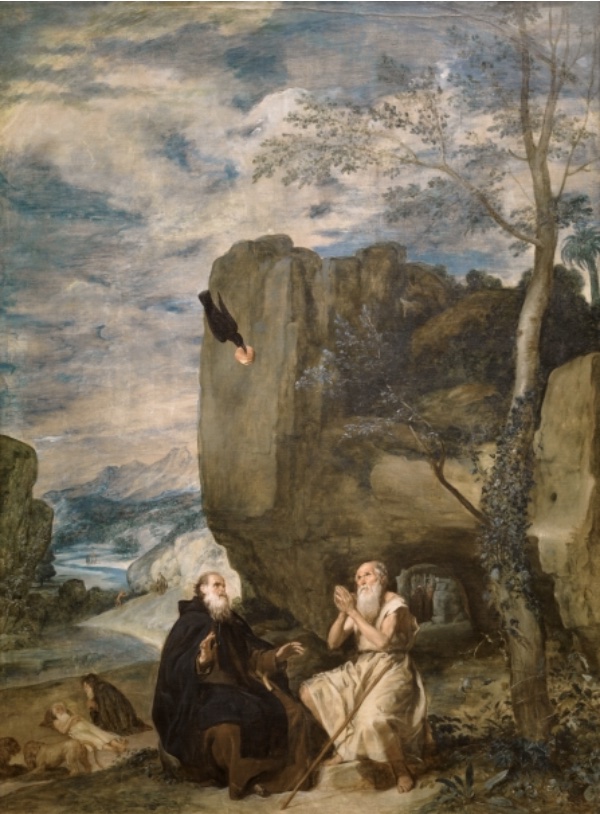
The piece I am doing my midterm podcast on is Saint Anthony Abbot and Saint Paul the Hermit, painted by Diego Veláquez. This painting was painted in 1635, a time when Catholicism was very much alive in Europe. Art costs money, so often the only people who were able to afford to commission paintings were the Church and crown. Because of this, most paintings that were commissioned were either portraits of royalty or religious.
Saint Paul was the first Hermit who was born around 227 AD in Egypt. He lived for 90 years as the first hermit, alone with God, living off of dates from a palm tree and in a cave in the desert near a stream of water. Eventually, God began to send him a raven with bread every day.
His presence was revealed by God to Saint Anthony the Abbot who was also a Hermit. Saint Anthony set out to find Saint Paul.
The painting Saint Anthony Abbot and Saint Paul the Hermit by Velázquez depicts the meeting of the two Saints. Velázquez uses lighting and shadows to guide the onlooker through the painting, and tells the story of the life of Saint Paul the Hermit.
This painting is of a scene with two men who are sitting down outside. One of the men is dressed in white and is looking up at a raven who is carrying food down to him. The other man is dressed in dark clothing. The light on the painting is on the man praying and the food that the raven is bringing. The man is looking up at the raven, which guides the audience’s attention to the food above. It can be inferred that this man was praying for food and that his prayers were answered from above.
It is from these details that would have given the onlooker in 1635 the context that these figures are Saint Anthony Abbot and Saint Paul the Hermit. The one dressed in white, looks a little more rough, and is summoning food, which indicates that he is Saint Paul the Hermit. The one in black is Saint Anthony Abbot. Saint Paul the Hermit has a very unconcerned, assured look on his face, while Saint Anothony Abbot seems to be in mid-motion and has a slightly surprised look on his face. This suggests Saint Anthony Abbot looks up to Saint Paul the Hermit.
Through background depictions of other versions of the two, the audience is walked through the meeting of the saints. The first one that my eye was drawn to is the one in the cave. In this segment, Saint Anthony abbott is facing the door in the cave up close as though waiting for someone to let him in.
However, from looking at another depiction in the background, we can see that he was likely not immediately let into the cave. This one shows saint paul the hermit walking up the hill towards saint anthony abbot. It seems as though this is the initial meeting between the pair because they seem to have less interaction than the others.
The last pair of people shown is saint anthony abbot kneeling down next to saint paul the hermit, who appears to be dead. Since he is kneeling down, it shows that saint anthony abbot respects saint paul the hermit.
This peaceful image gives homage to the life of saint paul the hermit. By using light and shadows, Velázquez not only tells the story of the two saints but also captures the faith and spiritual legacy of Saint Paul the Hermit.
Citation:
Velázquez, Diego. Saints Anthony Abbot and Paul the Hermit. ca. 1634–35, Museo del Prado, Madrid.
